Gregorian chant for children and any other curious sorts

Neuman’s News
- Goodbye for NowGod is mysterious, as we all know. A year ago, while spending time with the marvelous monks of St. Meinrad, the idea for this book was placed on my heart. I was in a dark time in my life, emotionally. The excitement for Neuman saved me in many ways. The pursuit of something beyond myself… Read more: Goodbye for Now
- Poetry in MotionHello, everyone! I know communication has been a bit sparse over the last few months, and obviously you have ALL noticed because you are at the edges of your seats waiting for more chant book info. Well, I’m here with an update. The reason I have had to pause my comic book writing briefly was… Read more: Poetry in Motion
- Chasing Chant in ItalyGreetings, everyone. I apologize for my absence from blogging over the past month, I never promised to be the best at blogging, but my enthusiasm for this book remains!! The past month has brought many exciting things. For today, I will talk about Italy. I was fortunate enough to spend eight days there recently. It… Read more: Chasing Chant in Italy
- Guido D’ArezzoToday I arrived on Guido. Of course, he will be a character in my book. His influence on ALL music, but especially chant was transformative!! It changed everything. He is the creator of the original staff AND solfège. Not exactly the solfège we learned from Maria BUT did you hear Julie Andrews is writing a… Read more: Guido D’Arezzo
- Hello!!So, I’ve gained a few followers (from all over the globe). That is VERY exciting. I would love to gain a few more. Please do not hesitate to tell your friends and neighbors, and the extra chatty lady at the checkout counter, that you know this person writing a comic book about chant. You never… Read more: Hello!!
-
About the Author
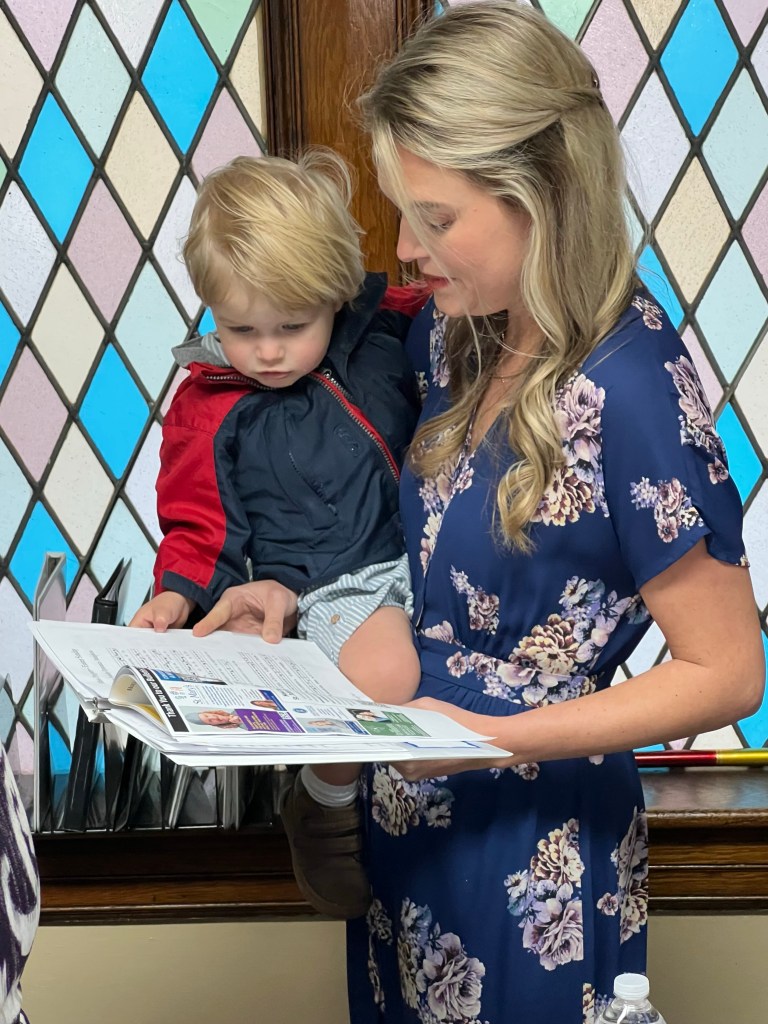
Hello, my name is Laura Scheele and I am writing a comic book about Gregorian Chant.
Why Me
(I guess the life story is a necessary evil of a blog)
To know why I should be the person to write this unique book, you must know me, SO, let’s start at the very beginning…
Once upon a time, in the far off land of childhood, a little girl danced around her living room (in cat pajamas) singing Les Mis to…her cats. At a young age I dreamed of being Eponine on stage (clearly a future artist, picking the heartbroken role at 5). My mom and Grandmother had a song for EVERYTHING, and music set the mood for all the family affairs. Our dinners were filled with smooth jazz and Simon and Garfunkel. Every Thanksgiving George Winton’s, December, came out to play. As winter melted away the Abbey Road cassette would find its way into my mom’s car, so we could sing in Spring with “Here Comes the Sun.” On my tenth birthday I saw my first musical (Phantom of the Opera), and I was sold. Music had won me over.
Fast forward a bit, to a teenage Laura. I did vocal training and show choir, but as most melodramatic teens do, I had a need to change the world!!! I saw many unkind and unsatisfied people around me, so of course at 16, I knew how to do life better. I decided to pursue elementary education. I still believe there is no greater way to impact cultural change than through young minds (get them while they’re still clay). BUT music was put on the backburner.
As a young adult, my focus was on education and a WHOLE lot of socialization! I was not the greatest student. I could be easily distracted. My best grades were always in writing courses because those came easy to me (took me many more years to make that connection). Eventually I DID become a kindergarten teacher. I truly loved teaching, I enjoyed coming up with stimulating lessons, I enjoyed my relationships with the students, I loved finding the perfect book to connect to a topic and I REALLY loved when I could incorporate music in lessons(so did the kids!).
After several years teaching, I had my first daughter, Elena. I stopped teaching to focus on her care. I had thought it would be a temporary pause, but three kids and eight years later, I’m not so sure. As I searched for who I was outside of my grown-up job, I finally found writing. After reading about 3621 children’s books, I was positive I could write one myself. After cleaning 5376 bottles, I was positive, I needed to start smaller. Poetry became my outlet, as well as singing, (full circle back to that little girl singing in her pj’s).
Now we get to the heart of the story. I saved the best for last. You might be thinking “something is missing here”… because, let’s be honest, one does not usually get THIS excited about Chant, without really being excited about the sacred first!
I grew up in a “spiritual,” but secular home. I always felt a presence…a watchful eye, something more, something waiting. My grandfather was a Pastor in the United Methodist church, though I never met him (he passed away when my father was eight), but I wonder if we had a bit in common. My looking for something more led me to MANY places, but I always felt most fulfilled when singing in a church. First it was the United Methodist Church through middle and high school, then (after some lost years in college) I met a wonderful man, who led me to the Catholic Church by asking me to marry him. He, and his mother :), made it very clear , it would be a Catholic wedding! That’s how my journey began, but if you asked Mr. Scheele now, he would readily admit, I quickly became “more Catholic” than him. The Church was exactly what I had been looking for, deep meaning, rich history, beautiful tradition and a tangible connection to something bigger than myself. Once 100% of my time was not dedicated to teaching or a newborn, I joined choir at St. John the Evangelist Catholic Church in Indianapolis…and THAT is where I met chant.
Why Chant
What do you think of when you think of Gregorian Chant? Maybe you think of Maria Von Trapp running back to the Abby from the mountains, maybe you think of a playlist from your yoga class, maybe a dark moment in a scary movie you watched (maybe nothing at all, and if that’s the case I love that journey for us, because I can teach you about it from scratch), but for the most part, when people think of Gregorian Chant, they think of something otherworldly, they think of being transported to another place. Hopefully, many people associate it with holy experiences in the Catholic Church, where they were transported somewhere ethereal. Sadly, even many Catholics, have very little experience with chant. This is a tragedy because the Catholic Church is where Gregorian chant began and was a major part of the Mass until Vatican II. It also laid the groundwork for ALL notated music!! The purpose of the Second Vatican council seemed to be a bit misinterpreted by some Catholic leaders. The effort was good, the hope was to find better ways to connect with local parish cultures, but the problem was, much of the sacred music and art were all but pushed out of the common Catholic Church. It is good to connect. It is essential in turning hearts towards Christ. I would argue, however, to keep those hearts you need to form a deeper connection. Also a WILL to connect on a deeper level. Art is needed to form that connection. Beautiful sacred art, at a young age can form lasting imprints on hearts.
The late Fr. Thomas Shields, who was also an educational psychologist, said
“The real foundations of character are not to be found in the intellect, but in the emotions, and the will, properly enlightened through the intellect, and it is through music and art that the imagination and the emotions may be reached and effectively developed.(1)”
I was not reached by chant at a young age, and when I first saw it, it seemed so foreign I really didn’t know what to think, but my search for a deeper connection led me to St. Meinrad Archabbey in Southern Indiana. That is where I first experienced chant “in the wild,” if you will. It was breathtaking. I was there for a workshop on chant, mostly just to feel more useful as a cantor. The whole experience was remarkable, but one moment I particularly remember was listening to an incredibly gifted nun sing Hildegard Von Bingen’s, Kyrie. The voice which came out of her felt angelic on its own, but along with the enchanting melismas (a group of notes sung to one syllable of text) of Hildegard, and the fact that it began snowing outside at that very moment, I was transported somewhere else, entirely.
music.apple.com/us/album/kyrie/1531838677
Br. John Glasenapp, the director of the Saint Meinrad institute for Sacred Music, describes the ability of chant to take you to a different place and time.
“That feeling of suspense, of not going anywhere, of not needing to resolve. It just is. And that can be very startling for people, because that’s not how the world works, and in that sense the liturgy is a different kind of space.” (2)
I believe it is important when you walk into the church, that you feel you are entering a “different” space. One which cannot be experienced anywhere else. One where time stops. Historical Theologian Dr. Marcellino D’Ambrosio states,
“As human beings, we are bound by time. We can’t live in any other moment than the present. The past is written in stone, and the future is unreachable. We are confined by the seconds, the minutes, and the hours. But God doesn’t have this limitation. God is not bound by time. He is in the past, the present, and the future, providing help and graces in all places on the time continuum.” (3)
This is what should be felt at the Mass. Chant can do that. Even more, however, Gregorian Chant is a sung prayer, directly from scripture. Chant is not something to enhance the Mass, but instead an integral part. As the late Fr. Columba Kelly once said, “It is drinking God straight.” (4) The Word of God is not paraphrased in chant. Fr. Columba Kelly did great work in helping translate many of the chants into English, so they could be more widely used today. He did that during a time when Gregorian chant was almost only being used by monastic communities. There is a resurgence of the original chant in Catholic churches across the country, but to truly connect the American Catholic church to our roots, will take a cultural shift within the church. Cultural shifts begin with children. THAT is where Neuman comes in.
So, who is Neuman?
This, is Neuman…
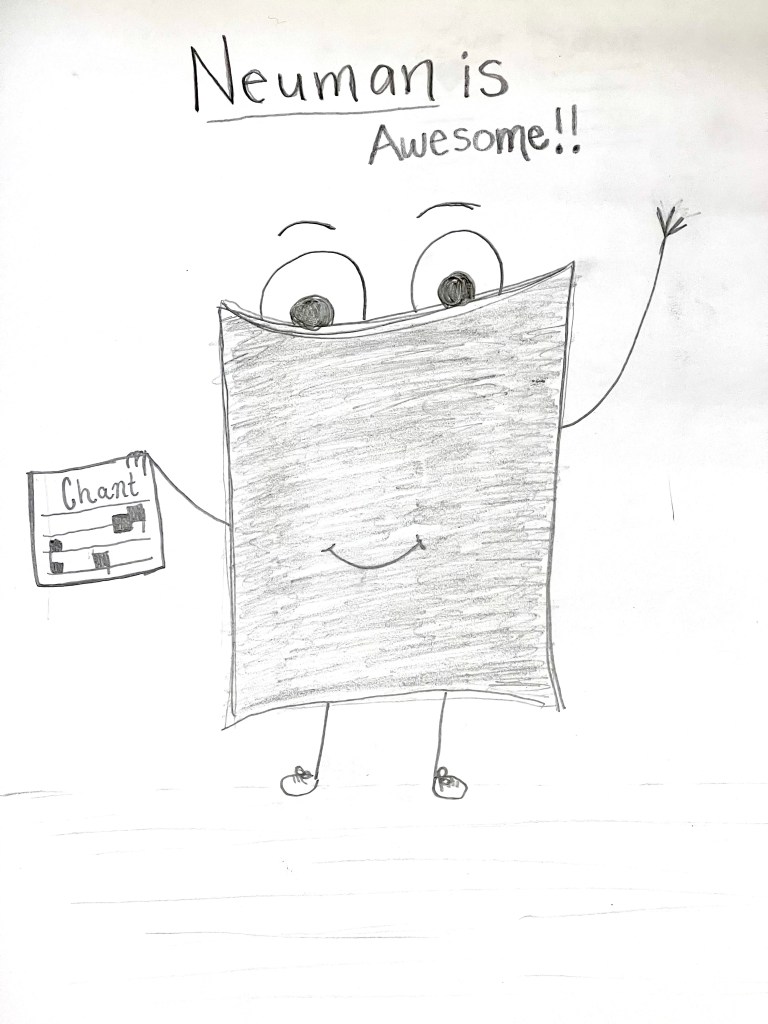
I would call him my creation, but I almost don’t want to take credit. During my time at St. Meinrad, as I was exposed and moved by chant, as we spoke of ways to bring the Tradition of chant back to the mainstream Catholic church; I went up to my room one evening and Neuman just poured out of me. In comic form. I had always wanted to write a children’s book. I also believed exposing children to chant was the way to bring it off the dusty library shelves and into the pews once more, I NEVER thought I would be writing a comic book. But there Neuman was, and he begged me to keep going. So I did.
Neuman is a punctum, he is part of the square notation of Gregorian chant. The pre-music note, music note. My goal is to have more than just square notation represented, it would be a tragedy to leave out the rich repertoire of chant notation, however, a punctum is a great starting point.
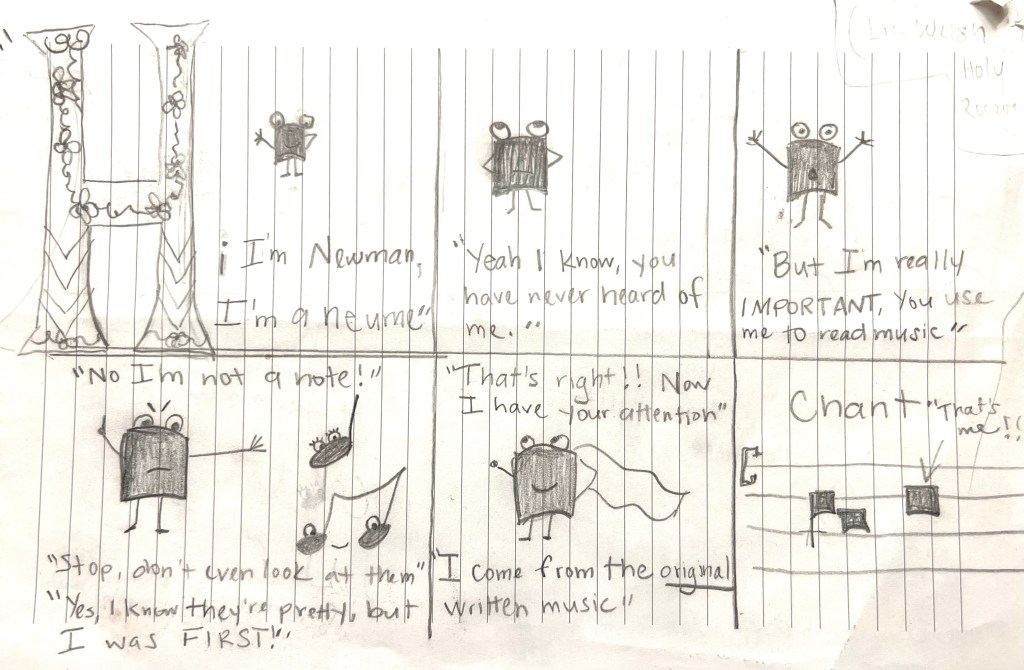
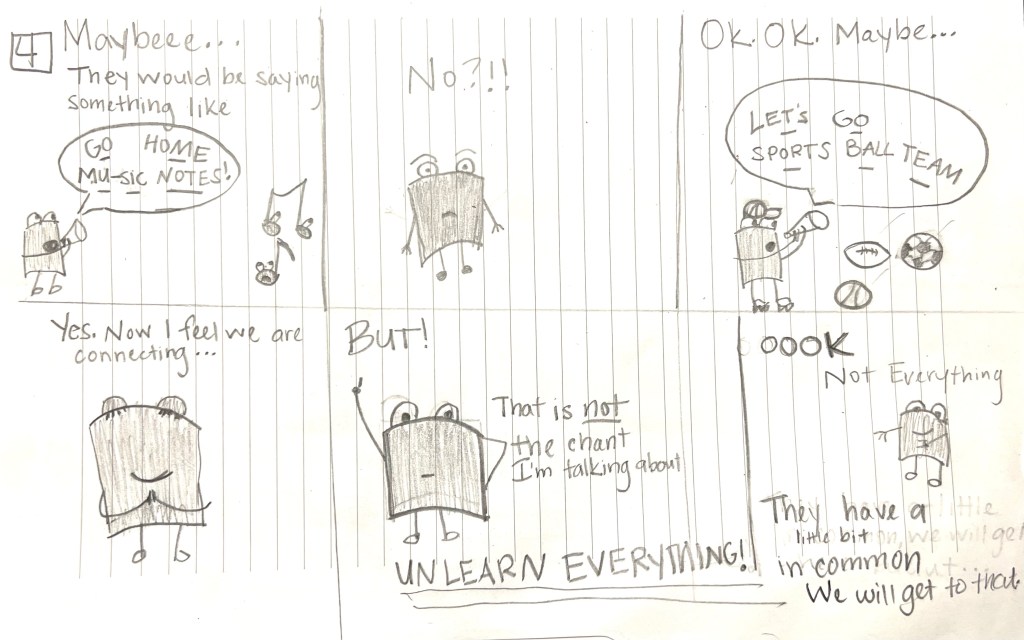
Neuman’s role is to lead children to an understanding of Gregorian chant, with comic art as his vehicle. Comic art, much like chant can be misunderstood. It is a tremendous tool for teaching. With the use of images and text, it has the ability to hold interest, express emotion, use symbols, present humor, and nuance. It can communicate with children at their level and in a way, just text, cannot.
It is truly better to show you than to tell you…
What would I like readers to take away?
There are many directions I could go with this book, but my main goals are listed below
Readers will
- Understand what Gregorian chant is, and its function.
- Gain some historical knowledge to understand the importance of learning chant.
- Understand how chant differs from modern music.
- Have a basic understanding of the square notation. (And exposure to a few others)
- Walk away with a will and excitement to learn more chants.
-
About the Author
Hello, my name is Laura Scheele and I am writing a comic book about Gregorian Chant.
Why Me
(I guess the life story is a necessary evil of a blog)
To know why I should be the person to write this unique book, you must know me, SO, let’s start at the very beginning…
Once upon a time, in the far off land of childhood, a little girl danced around her living room (in cat pajamas) singing Les Mis to…her cats. At a young age I dreamed of being Eponine on stage (clearly a future artist, picking the heartbroken role at 5). My mom and Grandmother had a song for EVERYTHING, and music set the mood for all the family affairs. Our dinners were filled with smooth jazz and Simon and Garfunkel. Every Thanksgiving George Winton’s, December, came out to play. As winter melted away the Abbey Road cassette would find its way into my mom’s car, so we could sing in Spring with “Here Comes the Sun.” On my tenth birthday I saw my first musical (Phantom of the Opera), and I was sold. Music had won me over.
Fast forward a bit, to a teenage Laura. I did vocal training and show choir, but as most melodramatic teens do, I had a need to change the world!!! I saw many unkind and unsatisfied people around me, so of course at 16, I knew how to do life better. I decided to pursue elementary education. I still believe there is no greater way to impact cultural change than through young minds (get them while they’re still clay). BUT music was put on the backburner.
As a young adult, my focus was on education and a WHOLE lot of socialization! I was not the greatest student. I could be easily distracted. My best grades were always in writing courses because those came easy to me (took me many more years to make that connection). Eventually I DID become a kindergarten teacher. I truly loved teaching, I enjoyed coming up with stimulating lessons, I enjoyed my relationships with the students, I loved finding the perfect book to connect to a topic and I REALLY loved when I could incorporate music in lessons(so did the kids!).
After several years teaching, I had my first daughter, Elena. I stopped teaching to focus on her care. I had thought it would be a temporary pause, but three kids and eight years later, I’m not so sure. As I searched for who I was outside of my grown-up job, I finally found writing. After reading about 3621 children’s books, I was positive I could write one myself. After cleaning 5376 bottles, I was positive, I needed to start smaller. Poetry became my outlet, as well as singing, (full circle back to that little girl singing in her pj’s).
Now we get to the heart of the story. I saved the best for last. You might be thinking “something is missing here”… because, let’s be honest, one does not usually get THIS excited about Chant, without really being excited about the sacred first!
I grew up in a “spiritual,” but secular home. I always felt a presence…a watchful eye, something more, something waiting. My grandfather was a Pastor in the United Methodist church, though I never met him (he passed away when my father was eight), but I wonder if we had a bit in common. My looking for something more led me to MANY places, but I always felt most fulfilled when singing in a church. First it was the United Methodist Church through middle and high school, then (after some lost years in college) I met a wonderful man, who led me to the Catholic Church by asking me to marry him. He, and his mother :), made it very clear , it would be a Catholic wedding! That’s how my journey began, but if you asked Mr. Scheele now, he would readily admit, I quickly became “more Catholic” than him. The Church was exactly what I had been looking for, deep meaning, rich history, beautiful tradition and a tangible connection to something bigger than myself. Once 100% of my time was not dedicated to teaching or a newborn, I joined choir at St. John the Evangelist Catholic Church in Indianapolis…and THAT is where I met chant.
Why Chant
What do you think of when you think of Gregorian Chant? Maybe you think of Maria Von Trapp running back to the Abby from the mountains, maybe you think of a playlist from your yoga class, maybe a dark moment in a scary movie you watched (maybe nothing at all, and if that’s the case I love that journey for us, because I can teach you about it from scratch), but for the most part, when people think of Gregorian Chant, they think of something otherworldly, they think of being transported to another place. Hopefully, many people associate it with holy experiences in the Catholic Church, where they were transported somewhere ethereal. Sadly, even many Catholics, have very little experience with chant. This is a tragedy because the Catholic Church is where Gregorian chant began and was a major part of the Mass until Vatican II. It also laid the groundwork for ALL notated music!! The purpose of the Second Vatican council seemed to be a bit misinterpreted by some Catholic leaders. The effort was good, the hope was to find better ways to connect with local parish cultures, but the problem was, much of the sacred music and art were all but pushed out of the common Catholic Church. It is good to connect. It is essential in turning hearts towards Christ. I would argue, however, to keep those hearts you need to form a deeper connection. Also a WILL to connect on a deeper level. Art is needed to form that connection. Beautiful sacred art, at a young age can form lasting imprints on hearts.
The late Fr. Thomas Shields, who was also an educational psychologist, said
“The real foundations of character are not to be found in the intellect, but in the emotions, and the will, properly enlightened through the intellect, and it is through music and art that the imagination and the emotions may be reached and effectively developed.(1)”
I was not reached by chant at a young age, and when I first saw it, it seemed so foreign I really didn’t know what to think, but my search for a deeper connection led me to St. Meinrad Archabbey in Southern Indiana. That is where I first experienced chant “in the wild,” if you will. It was breathtaking. I was there for a workshop on chant, mostly just to feel more useful as a cantor. The whole experience was remarkable, but one moment I particularly remember was listening to an incredibly gifted nun sing Hildegard Von Bingen’s, Kyrie. The voice which came out of her felt angelic on its own, but along with the enchanting melismas (a group of notes sung to one syllable of text) of Hildegard, and the fact that it began snowing outside at that very moment, I was transported somewhere else, entirely.
music.apple.com/us/album/kyrie/1531838677
Br. John Glasenapp, the director of the Saint Meinrad institute for Sacred Music, describes the ability of chant to take you to a different place and time.
“That feeling of suspense, of not going anywhere, of not needing to resolve. It just is. And that can be very startling for people, because that’s not how the world works, and in that sense the liturgy is a different kind of space.” (2)
I believe it is important when you walk into the church, that you feel you are entering a “different” space. One which cannot be experienced anywhere else. One where time stops. Historical Theologian Dr. Marcellino D’Ambrosio states,
“As human beings, we are bound by time. We can’t live in any other moment than the present. The past is written in stone, and the future is unreachable. We are confined by the seconds, the minutes, and the hours. But God doesn’t have this limitation. God is not bound by time. He is in the past, the present, and the future, providing help and graces in all places on the time continuum.” (3)
This is what should be felt at the Mass. Chant can do that. Even more, however, Gregorian Chant is a sung prayer, directly from scripture. Chant is not something to enhance the Mass, but instead an integral part. As the late Fr. Columba Kelly once said, “It is drinking God straight.” (4) The Word of God is not paraphrased in chant. Fr. Columba Kelly did great work in helping translate many of the chants into English, so they could be more widely used today. He did that during a time when Gregorian chant was almost only being used by monastic communities. There is a resurgence of the original chant in Catholic churches across the country, but to truly connect the American Catholic church to our roots, will take a cultural shift within the church. Cultural shifts begin with children. THAT is where Neuman comes in.
So, who is Neuman?
This, is Neuman…
I would call him my creation, but I almost don’t want to take credit. During my time at St. Meinrad, as I was exposed and moved by chant, as we spoke of ways to bring the Tradition of chant back to the mainstream Catholic church; I went up to my room one evening and Neuman just poured out of me. In comic form. I had always wanted to write a children’s book. I also believed exposing children to chant was the way to bring it off the dusty library shelves and into the pews once more, I NEVER thought I would be writing a comic book. But there Neuman was, and he begged me to keep going. So I did.
Neuman is a punctum, he is part of the square notation of Gregorian chant. The pre-music note, music note. My goal is to have more than just square notation represented, it would be a tragedy to leave out the rich repertoire of chant notation, however, a punctum is a great starting point.
Neuman’s role is to lead children to an understanding of Gregorian chant, with comic art as his vehicle. Comic art, much like chant can be misunderstood. It is a tremendous tool for teaching. With the use of images and text, it has the ability to hold interest, express emotion, use symbols, present humor, and nuance. It can communicate with children at their level and in a way, just text, cannot.
It is truly better to show you than to tell you…
What would I like readers to take away?
There are many directions I could go with this book, but my main goals are listed below
Readers will
- Understand what Gregorian chant is, and its function.
- Gain some historical knowledge to understand the importance of learning chant.
- Understand how chant differs from modern music.
- Have a basic understanding of the square notation. (And exposure to a few others)
- Walk away with a will and excitement to learn more chants.
-
About the Author
Hello, my name is Laura Scheele and I am writing a comic book about Gregorian Chant.
Why Me
(I guess the life story is a necessary evil of a blog)
To know why I should be the person to write this unique book, you must know me, SO, let’s start at the very beginning…
Once upon a time, in the far off land of childhood, a little girl danced around her living room (in cat pajamas) singing Les Mis to…her cats. At a young age I dreamed of being Eponine on stage (clearly a future artist, picking the heartbroken role at 5). My mom and Grandmother had a song for EVERYTHING, and music set the mood for all the family affairs. Our dinners were filled with smooth jazz and Simon and Garfunkel. Every Thanksgiving George Winton’s, December, came out to play. As winter melted away the Abbey Road cassette would find its way into my mom’s car, so we could sing in Spring with “Here Comes the Sun.” On my tenth birthday I saw my first musical (Phantom of the Opera), and I was sold. Music had won me over.
Fast forward a bit, to a teenage Laura. I did vocal training and show choir, but as most melodramatic teens do, I had a need to change the world!!! I saw many unkind and unsatisfied people around me, so of course at 16, I knew how to do life better. I decided to pursue elementary education. I still believe there is no greater way to impact cultural change than through young minds (get them while they’re still clay). BUT music was put on the backburner.
As a young adult, my focus was on education and a WHOLE lot of socialization! I was not the greatest student. I could be easily distracted. My best grades were always in writing courses because those came easy to me (took me many more years to make that connection). Eventually I DID become a kindergarten teacher. I truly loved teaching, I enjoyed coming up with stimulating lessons, I enjoyed my relationships with the students, I loved finding the perfect book to connect to a topic and I REALLY loved when I could incorporate music in lessons(so did the kids!).
After several years teaching, I had my first daughter, Elena. I stopped teaching to focus on her care. I had thought it would be a temporary pause, but three kids and eight years later, I’m not so sure. As I searched for who I was outside of my grown-up job, I finally found writing. After reading about 3621 children’s books, I was positive I could write one myself. After cleaning 5376 bottles, I was positive, I needed to start smaller. Poetry became my outlet, as well as singing, (full circle back to that little girl singing in her pj’s).
Now we get to the heart of the story. I saved the best for last. You might be thinking “something is missing here”… because, let’s be honest, one does not usually get THIS excited about Chant, without really being excited about the sacred first!
I grew up in a “spiritual,” but secular home. I always felt a presence…a watchful eye, something more, something waiting. My grandfather was a Pastor in the United Methodist church, though I never met him (he passed away when my father was eight), but I wonder if we had a bit in common. My looking for something more led me to MANY places, but I always felt most fulfilled when singing in a church. First it was the United Methodist Church through middle and high school, then (after some lost years in college) I met a wonderful man, who led me to the Catholic Church by asking me to marry him. He, and his mother :), made it very clear , it would be a Catholic wedding! That’s how my journey began, but if you asked Mr. Scheele now, he would readily admit, I quickly became “more Catholic” than him. The Church was exactly what I had been looking for, deep meaning, rich history, beautiful tradition and a tangible connection to something bigger than myself. Once 100% of my time was not dedicated to teaching or a newborn, I joined choir at St. John the Evangelist Catholic Church in Indianapolis…and THAT is where I met chant.
Why Chant
What do you think of when you think of Gregorian Chant? Maybe you think of Maria Von Trapp running back to the Abby from the mountains, maybe you think of a playlist from your yoga class, maybe a dark moment in a scary movie you watched (maybe nothing at all, and if that’s the case I love that journey for us, because I can teach you about it from scratch), but for the most part, when people think of Gregorian Chant, they think of something otherworldly, they think of being transported to another place. Hopefully, many people associate it with holy experiences in the Catholic Church, where they were transported somewhere ethereal. Sadly, even many Catholics, have very little experience with chant. This is a tragedy because the Catholic Church is where Gregorian chant began and was a major part of the Mass until Vatican II. It also laid the groundwork for ALL notated music!! The purpose of the Second Vatican council seemed to be a bit misinterpreted by some Catholic leaders. The effort was good, the hope was to find better ways to connect with local parish cultures, but the problem was, much of the sacred music and art were all but pushed out of the common Catholic Church. It is good to connect. It is essential in turning hearts towards Christ. I would argue, however, to keep those hearts you need to form a deeper connection. Also a WILL to connect on a deeper level. Art is needed to form that connection. Beautiful sacred art, at a young age can form lasting imprints on hearts.
The late Fr. Thomas Shields, who was also an educational psychologist, said
“The real foundations of character are not to be found in the intellect, but in the emotions, and the will, properly enlightened through the intellect, and it is through music and art that the imagination and the emotions may be reached and effectively developed.(1)”
I was not reached by chant at a young age, and when I first saw it, it seemed so foreign I really didn’t know what to think, but my search for a deeper connection led me to St. Meinrad Archabbey in Southern Indiana. That is where I first experienced chant “in the wild,” if you will. It was breathtaking. I was there for a workshop on chant, mostly just to feel more useful as a cantor. The whole experience was remarkable, but one moment I particularly remember was listening to an incredibly gifted nun sing Hildegard Von Bingen’s, Kyrie. The voice which came out of her felt angelic on its own, but along with the enchanting melismas (a group of notes sung to one syllable of text) of Hildegard, and the fact that it began snowing outside at that very moment, I was transported somewhere else, entirely.
music.apple.com/us/album/kyrie/1531838677
Br. John Glasenapp, the director of the Saint Meinrad institute for Sacred Music, describes the ability of chant to take you to a different place and time.
“That feeling of suspense, of not going anywhere, of not needing to resolve. It just is. And that can be very startling for people, because that’s not how the world works, and in that sense the liturgy is a different kind of space.” (2)
I believe it is important when you walk into the church, that you feel you are entering a “different” space. One which cannot be experienced anywhere else. One where time stops. Historical Theologian Dr. Marcellino D’Ambrosio states,
“As human beings, we are bound by time. We can’t live in any other moment than the present. The past is written in stone, and the future is unreachable. We are confined by the seconds, the minutes, and the hours. But God doesn’t have this limitation. God is not bound by time. He is in the past, the present, and the future, providing help and graces in all places on the time continuum.” (3)
This is what should be felt at the Mass. Chant can do that. Even more, however, Gregorian Chant is a sung prayer, directly from scripture. Chant is not something to enhance the Mass, but instead an integral part. As the late Fr. Columba Kelly once said, “It is drinking God straight.” (4) The Word of God is not paraphrased in chant. Fr. Columba Kelly did great work in helping translate many of the chants into English, so they could be more widely used today. He did that during a time when Gregorian chant was almost only being used by monastic communities. There is a resurgence of the original chant in Catholic churches across the country, but to truly connect the American Catholic church to our roots, will take a cultural shift within the church. Cultural shifts begin with children. THAT is where Neuman comes in.
So, who is Neuman?
This, is Neuman…
I would call him my creation, but I almost don’t want to take credit. During my time at St. Meinrad, as I was exposed and moved by chant, as we spoke of ways to bring the Tradition of chant back to the mainstream Catholic church; I went up to my room one evening and Neuman just poured out of me. In comic form. I had always wanted to write a children’s book. I also believed exposing children to chant was the way to bring it off the dusty library shelves and into the pews once more, I NEVER thought I would be writing a comic book. But there Neuman was, and he begged me to keep going. So I did.
Neuman is a punctum, he is part of the square notation of Gregorian chant. The pre-music note, music note. My goal is to have more than just square notation represented, it would be a tragedy to leave out the rich repertoire of chant notation, however, a punctum is a great starting point.
Neuman’s role is to lead children to an understanding of Gregorian chant, with comic art as his vehicle. Comic art, much like chant can be misunderstood. It is a tremendous tool for teaching. With the use of images and text, it has the ability to hold interest, express emotion, use symbols, present humor, and nuance. It can communicate with children at their level and in a way, just text, cannot.
It is truly better to show you than to tell you…
What would I like readers to take away?
There are many directions I could go with this book, but my main goals are listed below
Readers will
- Understand what Gregorian chant is, and its function.
- Gain some historical knowledge to understand the importance of learning chant.
- Understand how chant differs from modern music.
- Have a basic understanding of the square notation. (And exposure to a few others)
- Walk away with a will and excitement to learn more chants.
-
About the Author
Hello, my name is Laura Scheele and I am writing a comic book about Gregorian Chant.
Why Me
(I guess the life story is a necessary evil of a blog)
To know why I should be the person to write this unique book, you must know me, SO, let’s start at the very beginning…
Once upon a time, in the far off land of childhood, a little girl danced around her living room (in cat pajamas) singing Les Mis to…her cats. At a young age I dreamed of being Eponine on stage (clearly a future artist, picking the heartbroken role at 5). My mom and Grandmother had a song for EVERYTHING, and music set the mood for all the family affairs. Our dinners were filled with smooth jazz and Simon and Garfunkel. Every Thanksgiving George Winton’s, December, came out to play. As winter melted away the Abbey Road cassette would find its way into my mom’s car, so we could sing in Spring with “Here Comes the Sun.” On my tenth birthday I saw my first musical (Phantom of the Opera), and I was sold. Music had won me over.
Fast forward a bit, to a teenage Laura. I did vocal training and show choir, but as most melodramatic teens do, I had a need to change the world!!! I saw many unkind and unsatisfied people around me, so of course at 16, I knew how to do life better. I decided to pursue elementary education. I still believe there is no greater way to impact cultural change than through young minds (get them while they’re still clay). BUT music was put on the backburner.
As a young adult, my focus was on education and a WHOLE lot of socialization! I was not the greatest student. I could be easily distracted. My best grades were always in writing courses because those came easy to me (took me many more years to make that connection). Eventually I DID become a kindergarten teacher. I truly loved teaching, I enjoyed coming up with stimulating lessons, I enjoyed my relationships with the students, I loved finding the perfect book to connect to a topic and I REALLY loved when I could incorporate music in lessons(so did the kids!).
After several years teaching, I had my first daughter, Elena. I stopped teaching to focus on her care. I had thought it would be a temporary pause, but three kids and eight years later, I’m not so sure. As I searched for who I was outside of my grown-up job, I finally found writing. After reading about 3621 children’s books, I was positive I could write one myself. After cleaning 5376 bottles, I was positive, I needed to start smaller. Poetry became my outlet, as well as singing, (full circle back to that little girl singing in her pj’s).
Now we get to the heart of the story. I saved the best for last. You might be thinking “something is missing here”… because, let’s be honest, one does not usually get THIS excited about Chant, without really being excited about the sacred first!
I grew up in a “spiritual,” but secular home. I always felt a presence…a watchful eye, something more, something waiting. My grandfather was a Pastor in the United Methodist church, though I never met him (he passed away when my father was eight), but I wonder if we had a bit in common. My looking for something more led me to MANY places, but I always felt most fulfilled when singing in a church. First it was the United Methodist Church through middle and high school, then (after some lost years in college) I met a wonderful man, who led me to the Catholic Church by asking me to marry him. He, and his mother :), made it very clear , it would be a Catholic wedding! That’s how my journey began, but if you asked Mr. Scheele now, he would readily admit, I quickly became “more Catholic” than him. The Church was exactly what I had been looking for, deep meaning, rich history, beautiful tradition and a tangible connection to something bigger than myself. Once 100% of my time was not dedicated to teaching or a newborn, I joined choir at St. John the Evangelist Catholic Church in Indianapolis…and THAT is where I met chant.
Why Chant
What do you think of when you think of Gregorian Chant? Maybe you think of Maria Von Trapp running back to the Abby from the mountains, maybe you think of a playlist from your yoga class, maybe a dark moment in a scary movie you watched (maybe nothing at all, and if that’s the case I love that journey for us, because I can teach you about it from scratch), but for the most part, when people think of Gregorian Chant, they think of something otherworldly, they think of being transported to another place. Hopefully, many people associate it with holy experiences in the Catholic Church, where they were transported somewhere ethereal. Sadly, even many Catholics, have very little experience with chant. This is a tragedy because the Catholic Church is where Gregorian chant began and was a major part of the Mass until Vatican II. It also laid the groundwork for ALL notated music!! The purpose of the Second Vatican council seemed to be a bit misinterpreted by some Catholic leaders. The effort was good, the hope was to find better ways to connect with local parish cultures, but the problem was, much of the sacred music and art were all but pushed out of the common Catholic Church. It is good to connect. It is essential in turning hearts towards Christ. I would argue, however, to keep those hearts you need to form a deeper connection. Also a WILL to connect on a deeper level. Art is needed to form that connection. Beautiful sacred art, at a young age can form lasting imprints on hearts.
The late Fr. Thomas Shields, who was also an educational psychologist, said
“The real foundations of character are not to be found in the intellect, but in the emotions, and the will, properly enlightened through the intellect, and it is through music and art that the imagination and the emotions may be reached and effectively developed.(1)”
I was not reached by chant at a young age, and when I first saw it, it seemed so foreign I really didn’t know what to think, but my search for a deeper connection led me to St. Meinrad Archabbey in Southern Indiana. That is where I first experienced chant “in the wild,” if you will. It was breathtaking. I was there for a workshop on chant, mostly just to feel more useful as a cantor. The whole experience was remarkable, but one moment I particularly remember was listening to an incredibly gifted nun sing Hildegard Von Bingen’s, Kyrie. The voice which came out of her felt angelic on its own, but along with the enchanting melismas (a group of notes sung to one syllable of text) of Hildegard, and the fact that it began snowing outside at that very moment, I was transported somewhere else, entirely.
music.apple.com/us/album/kyrie/1531838677
Br. John Glasenapp, the director of the Saint Meinrad institute for Sacred Music, describes the ability of chant to take you to a different place and time.
“That feeling of suspense, of not going anywhere, of not needing to resolve. It just is. And that can be very startling for people, because that’s not how the world works, and in that sense the liturgy is a different kind of space.” (2)
I believe it is important when you walk into the church, that you feel you are entering a “different” space. One which cannot be experienced anywhere else. One where time stops. Historical Theologian Dr. Marcellino D’Ambrosio states,
“As human beings, we are bound by time. We can’t live in any other moment than the present. The past is written in stone, and the future is unreachable. We are confined by the seconds, the minutes, and the hours. But God doesn’t have this limitation. God is not bound by time. He is in the past, the present, and the future, providing help and graces in all places on the time continuum.” (3)
This is what should be felt at the Mass. Chant can do that. Even more, however, Gregorian Chant is a sung prayer, directly from scripture. Chant is not something to enhance the Mass, but instead an integral part. As the late Fr. Columba Kelly once said, “It is drinking God straight.” (4) The Word of God is not paraphrased in chant. Fr. Columba Kelly did great work in helping translate many of the chants into English, so they could be more widely used today. He did that during a time when Gregorian chant was almost only being used by monastic communities. There is a resurgence of the original chant in Catholic churches across the country, but to truly connect the American Catholic church to our roots, will take a cultural shift within the church. Cultural shifts begin with children. THAT is where Neuman comes in.
So, who is Neuman?
This, is Neuman…
I would call him my creation, but I almost don’t want to take credit. During my time at St. Meinrad, as I was exposed and moved by chant, as we spoke of ways to bring the Tradition of chant back to the mainstream Catholic church; I went up to my room one evening and Neuman just poured out of me. In comic form. I had always wanted to write a children’s book. I also believed exposing children to chant was the way to bring it off the dusty library shelves and into the pews once more, I NEVER thought I would be writing a comic book. But there Neuman was, and he begged me to keep going. So I did.
Neuman is a punctum, he is part of the square notation of Gregorian chant. The pre-music note, music note. My goal is to have more than just square notation represented, it would be a tragedy to leave out the rich repertoire of chant notation, however, a punctum is a great starting point.
Neuman’s role is to lead children to an understanding of Gregorian chant, with comic art as his vehicle. Comic art, much like chant can be misunderstood. It is a tremendous tool for teaching. With the use of images and text, it has the ability to hold interest, express emotion, use symbols, present humor, and nuance. It can communicate with children at their level and in a way, just text, cannot.
It is truly better to show you than to tell you…
What would I like readers to take away?
There are many directions I could go with this book, but my main goals are listed below
Readers will
- Understand what Gregorian chant is, and its function.
- Gain some historical knowledge to understand the importance of learning chant.
- Understand how chant differs from modern music.
- Have a basic understanding of the square notation. (And exposure to a few others)
- Walk away with a will and excitement to learn more chants.
-
About the Author
Hello, my name is Laura Scheele and I am writing a comic book about Gregorian Chant.
Why Me
(I guess the life story is a necessary evil of a blog)
To know why I should be the person to write this unique book, you must know me, SO, let’s start at the very beginning…
Once upon a time, in the far off land of childhood, a little girl danced around her living room (in cat pajamas) singing Les Mis to…her cats. At a young age I dreamed of being Eponine on stage (clearly a future artist, picking the heartbroken role at 5). My mom and Grandmother had a song for EVERYTHING, and music set the mood for all the family affairs. Our dinners were filled with smooth jazz and Simon and Garfunkel. Every Thanksgiving George Winton’s, December, came out to play. As winter melted away the Abbey Road cassette would find its way into my mom’s car, so we could sing in Spring with “Here Comes the Sun.” On my tenth birthday I saw my first musical (Phantom of the Opera), and I was sold. Music had won me over.
Fast forward a bit, to a teenage Laura. I did vocal training and show choir, but as most melodramatic teens do, I had a need to change the world!!! I saw many unkind and unsatisfied people around me, so of course at 16, I knew how to do life better. I decided to pursue elementary education. I still believe there is no greater way to impact cultural change than through young minds (get them while they’re still clay). BUT music was put on the backburner.
As a young adult, my focus was on education and a WHOLE lot of socialization! I was not the greatest student. I could be easily distracted. My best grades were always in writing courses because those came easy to me (took me many more years to make that connection). Eventually I DID become a kindergarten teacher. I truly loved teaching, I enjoyed coming up with stimulating lessons, I enjoyed my relationships with the students, I loved finding the perfect book to connect to a topic and I REALLY loved when I could incorporate music in lessons(so did the kids!).
After several years teaching, I had my first daughter, Elena. I stopped teaching to focus on her care. I had thought it would be a temporary pause, but three kids and eight years later, I’m not so sure. As I searched for who I was outside of my grown-up job, I finally found writing. After reading about 3621 children’s books, I was positive I could write one myself. After cleaning 5376 bottles, I was positive, I needed to start smaller. Poetry became my outlet, as well as singing, (full circle back to that little girl singing in her pj’s).
Now we get to the heart of the story. I saved the best for last. You might be thinking “something is missing here”… because, let’s be honest, one does not usually get THIS excited about Chant, without really being excited about the sacred first!
I grew up in a “spiritual,” but secular home. I always felt a presence…a watchful eye, something more, something waiting. My grandfather was a Pastor in the United Methodist church, though I never met him (he passed away when my father was eight), but I wonder if we had a bit in common. My looking for something more led me to MANY places, but I always felt most fulfilled when singing in a church. First it was the United Methodist Church through middle and high school, then (after some lost years in college) I met a wonderful man, who led me to the Catholic Church by asking me to marry him. He, and his mother :), made it very clear , it would be a Catholic wedding! That’s how my journey began, but if you asked Mr. Scheele now, he would readily admit, I quickly became “more Catholic” than him. The Church was exactly what I had been looking for, deep meaning, rich history, beautiful tradition and a tangible connection to something bigger than myself. Once 100% of my time was not dedicated to teaching or a newborn, I joined choir at St. John the Evangelist Catholic Church in Indianapolis…and THAT is where I met chant.
Why Chant
What do you think of when you think of Gregorian Chant? Maybe you think of Maria Von Trapp running back to the Abby from the mountains, maybe you think of a playlist from your yoga class, maybe a dark moment in a scary movie you watched (maybe nothing at all, and if that’s the case I love that journey for us, because I can teach you about it from scratch), but for the most part, when people think of Gregorian Chant, they think of something otherworldly, they think of being transported to another place. Hopefully, many people associate it with holy experiences in the Catholic Church, where they were transported somewhere ethereal. Sadly, even many Catholics, have very little experience with chant. This is a tragedy because the Catholic Church is where Gregorian chant began and was a major part of the Mass until Vatican II. It also laid the groundwork for ALL notated music!! The purpose of the Second Vatican council seemed to be a bit misinterpreted by some Catholic leaders. The effort was good, the hope was to find better ways to connect with local parish cultures, but the problem was, much of the sacred music and art were all but pushed out of the common Catholic Church. It is good to connect. It is essential in turning hearts towards Christ. I would argue, however, to keep those hearts you need to form a deeper connection. Also a WILL to connect on a deeper level. Art is needed to form that connection. Beautiful sacred art, at a young age can form lasting imprints on hearts.
The late Fr. Thomas Shields, who was also an educational psychologist, said
“The real foundations of character are not to be found in the intellect, but in the emotions, and the will, properly enlightened through the intellect, and it is through music and art that the imagination and the emotions may be reached and effectively developed.(1)”
I was not reached by chant at a young age, and when I first saw it, it seemed so foreign I really didn’t know what to think, but my search for a deeper connection led me to St. Meinrad Archabbey in Southern Indiana. That is where I first experienced chant “in the wild,” if you will. It was breathtaking. I was there for a workshop on chant, mostly just to feel more useful as a cantor. The whole experience was remarkable, but one moment I particularly remember was listening to an incredibly gifted nun sing Hildegard Von Bingen’s, Kyrie. The voice which came out of her felt angelic on its own, but along with the enchanting melismas (a group of notes sung to one syllable of text) of Hildegard, and the fact that it began snowing outside at that very moment, I was transported somewhere else, entirely.
music.apple.com/us/album/kyrie/1531838677
Br. John Glasenapp, the director of the Saint Meinrad institute for Sacred Music, describes the ability of chant to take you to a different place and time.
“That feeling of suspense, of not going anywhere, of not needing to resolve. It just is. And that can be very startling for people, because that’s not how the world works, and in that sense the liturgy is a different kind of space.” (2)
I believe it is important when you walk into the church, that you feel you are entering a “different” space. One which cannot be experienced anywhere else. One where time stops. Historical Theologian Dr. Marcellino D’Ambrosio states,
“As human beings, we are bound by time. We can’t live in any other moment than the present. The past is written in stone, and the future is unreachable. We are confined by the seconds, the minutes, and the hours. But God doesn’t have this limitation. God is not bound by time. He is in the past, the present, and the future, providing help and graces in all places on the time continuum.” (3)
This is what should be felt at the Mass. Chant can do that. Even more, however, Gregorian Chant is a sung prayer, directly from scripture. Chant is not something to enhance the Mass, but instead an integral part. As the late Fr. Columba Kelly once said, “It is drinking God straight.” (4) The Word of God is not paraphrased in chant. Fr. Columba Kelly did great work in helping translate many of the chants into English, so they could be more widely used today. He did that during a time when Gregorian chant was almost only being used by monastic communities. There is a resurgence of the original chant in Catholic churches across the country, but to truly connect the American Catholic church to our roots, will take a cultural shift within the church. Cultural shifts begin with children. THAT is where Neuman comes in.
So, who is Neuman?
This, is Neuman…
I would call him my creation, but I almost don’t want to take credit. During my time at St. Meinrad, as I was exposed and moved by chant, as we spoke of ways to bring the Tradition of chant back to the mainstream Catholic church; I went up to my room one evening and Neuman just poured out of me. In comic form. I had always wanted to write a children’s book. I also believed exposing children to chant was the way to bring it off the dusty library shelves and into the pews once more, I NEVER thought I would be writing a comic book. But there Neuman was, and he begged me to keep going. So I did.
Neuman is a punctum, he is part of the square notation of Gregorian chant. The pre-music note, music note. My goal is to have more than just square notation represented, it would be a tragedy to leave out the rich repertoire of chant notation, however, a punctum is a great starting point.
Neuman’s role is to lead children to an understanding of Gregorian chant, with comic art as his vehicle. Comic art, much like chant can be misunderstood. It is a tremendous tool for teaching. With the use of images and text, it has the ability to hold interest, express emotion, use symbols, present humor, and nuance. It can communicate with children at their level and in a way, just text, cannot.
It is truly better to show you than to tell you…
What would I like readers to take away?
There are many directions I could go with this book, but my main goals are listed below
Readers will
- Understand what Gregorian chant is, and its function.
- Gain some historical knowledge to understand the importance of learning chant.
- Understand how chant differs from modern music.
- Have a basic understanding of the square notation. (And exposure to a few others)
- Walk away with a will and excitement to learn more chants.
References:
1.Zuberbueler, Amy. What is The Ward Method? https://musicasacra.com/music-pedagogy-for-children/ward-method-instruction/
2. Ministry Monday. (2021, March 8) #145: (Part 2) A Historical Intervention on the Basis of Chant. https://youtu.be/ICoAQ2n62Q0?list=PLidUYie8OHdXI6HN1kcx9glQt3tOUXaOQ
3. Dr. D’Ambrosio, Marcellino. (2022, May 10) Time Travel and Sunday Mass. (https://media.ascensionpress.com/2022/05/10/time-travel-and-sunday-mass/?fbclid=IwAR0VCdkgjadGFffe9bUffC9wRL_ytapb1pmHznVVX3Z2zdjk0AjxDJ1uWMY)
4. Echoes From the Bell Tower. (2017, June 22) CHANT: Drinking God Straight. https://www.saintmeinrad.edu/seminary-blog/echoes-from-the-bell-tower/chant-drinking-god-straight/
5. Tymms, W. R.: “The Art of Illuminating As Practised in Europe from the Earliest Times” (1860)
 Choose Chant